
PIC Coastal Classic: Proper preparation prevents poor performance
Preparing boat and crew for the great race north
By Suellen Hurling
There is an old saying - usually expressed with one or two words that are best left ashore - that proper preparation prevents poor performance.
For the PIC Coastal Classic, preparation means much more than checking the weather forecast and loading a few zip-lock bags of snacks. A well-prepared boat is paramount, and a good skipper is someone who has planned carefully and has a crew who understand the boat, their responsibilities and one another.
Before leaving the dock, every crew member should know where to find the essential safety equipment. Where are the seacocks? The first-aid kit? The EPIRB? The fire extinguishers and lifejackets?
It sounds basic, but basic things are often the easiest to overlook. When you’re offshore, a small problem can become a serious one remarkably quickly, especially when it is dark, the boat is moving and people are tired.
A proper crew induction should therefore be part of every boat’s pre-race preparation. It should cover the location and use of safety equipment, emergency procedures, communications, watchkeeping and what is expected of each person on board. The crew should be encouraged to ask questions. It is much better to feel briefly inexperienced at the dock than completely unprepared off Cape Brett.
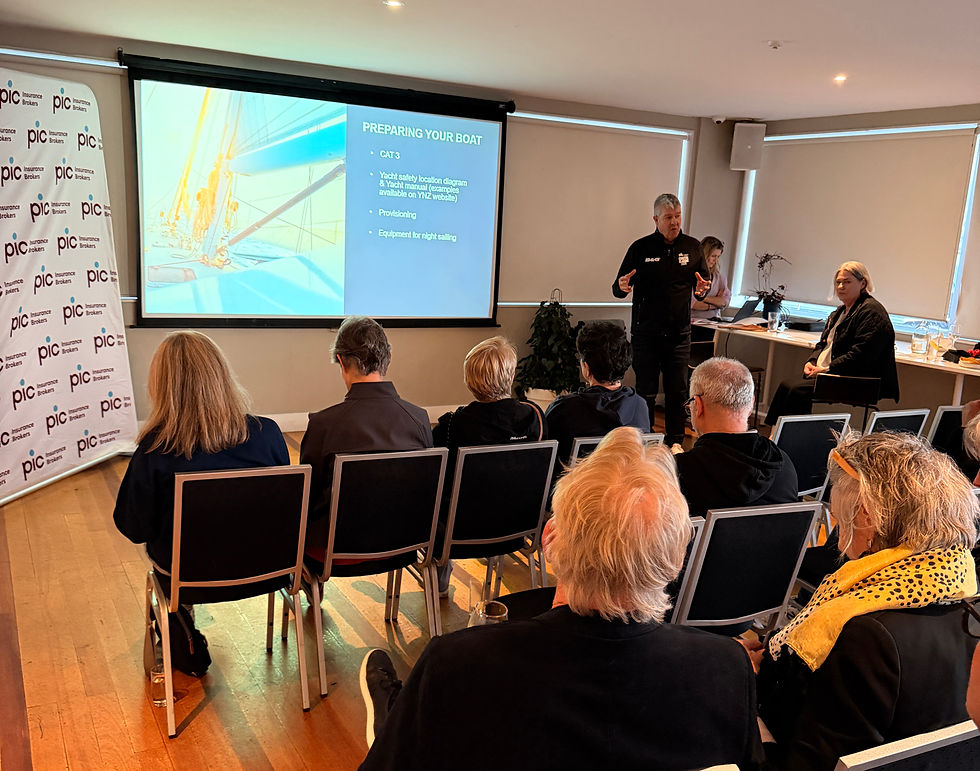
At the Boat Preparation Clinic ahead of the 2026 PIC Coastal Classic, Simon Hull, veteran competitor and a member of the organising team who puts the race together, went over some of the main points that are often forgotten in the lead up to the 119nm race.
Prepare for the situations nobody wants
Does everyone on board know what to do if a person goes overboard? A person-overboard situation can turn tragic in seconds unless the crew know how to react, who is taking charge and where the necessary equipment is kept. The recovery procedure should be discussed - and preferably practised - before the race.
Harnesses and tethers are equally important, particularly on deck at night or in difficult conditions.
“If you’re clipped on, you might get bruised if you go overboard, but at least you’re easier to pick up. And don’t be a hero - be smart,” said Simon, who has competed in “30’ish” PIC Coastal Classic Races, and has been part of the organising committee for almost 10 years.
Competitors should have a clear understanding about the event’s lifejacket requirements and their skipper’s instructions before the start. Those instructions need to be understood by everybody, not discovered midway through the race when conditions have already deteriorated.
There is no prize for unnecessary heroics. Being clipped on, wearing the right equipment and speaking up when something feels unsafe are signs of good seamanship - not timidity.
Prepare the safety equipment before you need it
Safety equipment is only useful if it works and the crew knows how to use it. The same applies to the boat itself.
“I wouldn’t go past Kawau unless I knew that the reefing lines work and that the crew know how to put a reef in,” stated Simon.
Reefing should not be something the crew attempts for the first time at night in a building breeze. Sail changes, reefing systems and essential deck equipment should be checked before the race, with responsibilities agreed in advance.
Fuel, water and food (and decent snacks) are obvious necessities. So are working navigation lights, reliable communications and a properly monitored VHF radio, including Channel 16.
Personal equipment is up there on the importance list as well. Headlamps should have a red-light setting so the crew can see without destroying everyone’s night vision. Sunscreen, warm and waterproof clothing, suitable footwear and dry spare clothes all contribute to safety and performance.
Clean underwear may not feature in the briefing, but experienced competitors will understand its value.
Look after the crew
As the clinic continued, other subjects were discussed.
Crew wellbeing may be the most important part of preparation because it touches everything: safety, concentration, decision-making and morale.
A hot meal can restore morale surprisingly quickly. So can regular snacks, enough water and a few hours of proper rest. Tired, cold and hungry sailors make poor decisions, and even highly experienced people become less effective when fatigue sets in.
Watch systems should be planned with the conditions and the experience of the crew in mind. Not everyone can steer a boat safely in a seaway at night. Watches should balance experience with inexperience, without leaving a less capable group unsupported.
The Coastal can be won or lost during the night, when crews are tired and concentration begins to slip. A real hero is not the person who boasts about staying awake for the entire race. It is the person who has managed their energy well enough to drive the boat properly at four in the morning.
Skippers should also make it clear that alcohol (and anything else that impairs judgement) belongs at the post-race celebration, once the boat is secure and every pair of feet is safely back on dry land.
Keep your head out of the boat
Modern instruments and navigation systems provide valuable information, but they are no substitute for awareness. Crews must keep looking outside the boat: at the seastate, the weather, surrounding traffic, sail trim and one another.
Good preparation gives people the capacity to do that. When everybody understands the boat and knows what is expected of them, fewer problems demand hurried solutions. The crew can concentrate on sailing well rather than scrambling to work out what to do next.
Before heading north, skippers and crews should remember the essentials:
Induct and brief every crew member.
Check the boat and all safety equipment.
Make sure everyone knows the person-overboard procedure.
Confirm that reefing systems work, and that the crew can use them.
Plan watches around experience and capability.
Wear lifejackets and clip on when required.
Monitor Channel 16.
Carry enough food, water, fuel and warm clothing.
Have a decent stash of accessible snacks Use red headlamps at night.
Eat, hydrate and rest.
Keep looking outside the boat.
Ask questions and speak up.
Don’t be a hero.
Above all, don’t be daft.
A little humour belongs in any long yacht race. Complacency does not. Proper preparation may not guarantee a fast passage to Russell, but it gives every crew a much better chance of arriving safely, performing well, and still enjoying one another’s company at the finish.
Entries for the 2026 PIC Coastal Classic close on Monday 12 October.


Comments